
If you’re already wearing dentures and dealing with slipping, clicking, sore spots, or the daily hassle of adhesive, you may be wondering whether full mouth dental implants could replace them for good. The good news: switching from dentures to implants is one of the most common transitions we help patients through, and it’s usually more straightforward than people expect.
Can You Switch From Dentures to Implants?
In most cases, yes. Many patients who start with dentures later move to an implant-supported solution once they’re ready for the investment or want more stability. The main factor is jawbone density; because dentures don’t stimulate the jaw the way natural teeth or implants do, bone loss can continue the longer dentures are worn, which is why an evaluation is the first real step, not an assumption either way.

What the Evaluation Looks Like
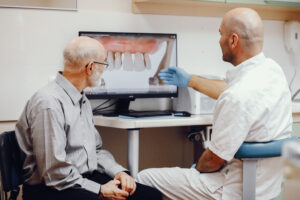
We start with a clinical exam and imaging (X-rays or a 3D scan) to check how much bone is available in the upper and lower jaw. If there’s been significant bone loss, that doesn’t rule out implants; it usually just means a bone grafting procedure is added to the plan first to rebuild a stable foundation before implants are placed.
Your Two Main Options
- Implant-supported (overdenture): A small number of implants (often 2–4 per arch) anchor your existing-style denture in place. It still comes out for cleaning, but it snaps onto the implants instead of relying on suction or adhesive, dramatically improving stability.
All-on-4 / fixed full-arch: Four (or more) implants per arch support a fixed bridge that doesn’t come out at all. it functions and feels much closer to natural teeth. Full details on the fixed approach are on our All-on-X Implants page.
What Actually Changes Day to Day
- No more adhesive, and no more worrying about a denture shifting while you eat, laugh, or talk
- Significantly improved chewing force compared to a traditional denture resting on the gums
- An overdenture still comes out nightly for cleaning; a fixed full-arch does not, and is cared for more like natural teeth
- Ongoing bone preservation, since the implants themselves stimulate the jaw the way your original tooth roots did
What the Process Involves
After the evaluation (and grafting, if needed), implants are surgically placed, typically under sedation for comfort. Healing and osseointegration take a few months, during which a temporary prosthetic keeps you functional. Once healed, your final implant-supported denture or fixed bridge is attached. For a full walkthrough of the implant process itself, see our complete guide to full mouth dental implants.
Financing the Switch
A full-arch implant upgrade is a significant investment, and we understand it’s not a decision made lightly after already paying for dentures once. Family Dentistry of Crystal Lake offers financing through Cherry and CareCredit, including 0% APR plans with no hard credit check, to help spread the cost.
Ready to See if You’re a Candidate?
The only way to know your specific options is a consultation with imaging to check your bone health. Call (815) 444-6444 or schedule online and we’ll go over what switching from dentures to implants would look like for you.